
Reflections on Being a Gay Activist in 1970s West Germany
(2026)
Les K Wright
The first and, sadly, short-lived modern gay movement occurred in the Weimar Republic (1919-1933) of Germany. Germany’s first experiment with democracy provided ample freedom for progressive social, cultural, and political pursuits. This was also a time of hyperinflation, which made economic survival precarious for many. Germany was forced to pay reparations for starting World War I and the Germans’ fear and resentment over this planted the seeds for World War II. Berlin in the “Golden Twenties” was an intoxicating place, where gay men and lesbians were tolerated enough to become publicly visible. Sexologist and sexual reformer Magnus Hirschfeld opened the Institut für Sexualwissenschaft (Institute for Sexual Science) in Berlin-Tiergarten in 1919. He offered a safe space for queer people, documented and studied homosexuality, and advocated for an end to social and legal homophobia. His arguments were grounded in science. The sexually free and breezy Berin Christpher Isherwood wrote about in The Berlin Stories (latermade into the musical Cabaret) existed because of hyperinflation. Plenty of straight working-class men willingly “played for pay” to cover their rent and put food on their tables.
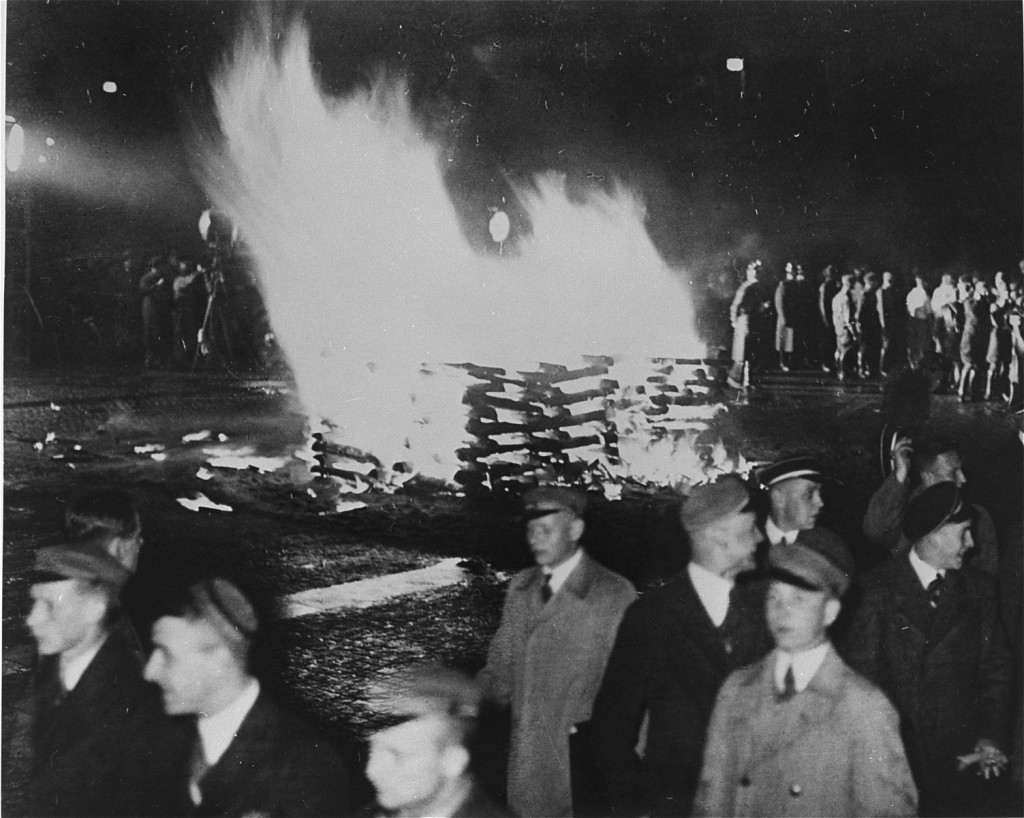
This all came crashing to an end with Hitler’s ascent to power. The infamous public book burning of the Institute for Sexual Science’s library’s extensive collection and archives—representing decades of research on gender identity and sexuality—took place on May 10, 1933, on Opernplatz (now Bebelplatz). This marked the beginning of the Nazi war on homosexuals (1933-1945). This culminated in the incarceration of gay men in the concentration camps, where they were forced to wear a pink triangle. Identified thus, gay men found themselves at the lowest rung in the death camp hierarchy, singled out for further homophobia-driven abuse and ostracism by fellow inmates. Jewish gay men suffered the worst.
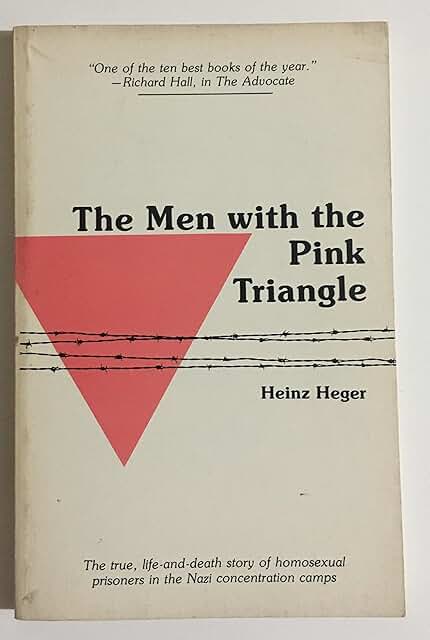
Published in 1972, Heinz Heger’s memoir Die Männer mit dem rosa Winkel (The Men with the Pink) is one of very few first-hand accounts of the treatment of homosexuals In Nazi imprisonment. It was read widely. Its publication helped to illuminate not just the suffering gay prisoners of the Nazi regime experienced, but the lack of recognition and compensation they received after the war’s end. It inspired Martinn Sherman’s 1979 pay Bent, which was made into a movie by Sean Mathias in 1997.. In 1975 HAM (Homo Aktion Munich) appropriated wearing the pink triangle, stating “we perceive this society [BRD] as a new concentration camp.” West German police kept illegal rosa Listen (pink lists), secret files of license plates numbers written down at cruising spaces. I once questioned a cop who was doing this at a public toilet in Tübingen. He informed me it was so the police could know who we are so they could “keep us safe.”
At the end of World War II the Allied forces occupied Germany and divided both the country and kits capital Berlin into four zones. The British occupied the north, the French the west, the Americans the south, and the Soviet Russians the east. To its eternal shame (in this writer’s opinion), the new Federal Republic adopted the Nazi-era Paragraph 175 (the law criminalizing homosexuality) unchanged. Between 1953 and 1965 there were more prosecutions than in the entire Nazi period, including 25,000 guilty verdicts. The first loosening of Paragraph 175 took place in 1969. The 1935 version of Paragraph 175 was liberalized, decriminalizing most sexual relations between men over the age of 21. Convictions of gay men for sex crimes immediately dropped from approximately 2,000 per year to 400.
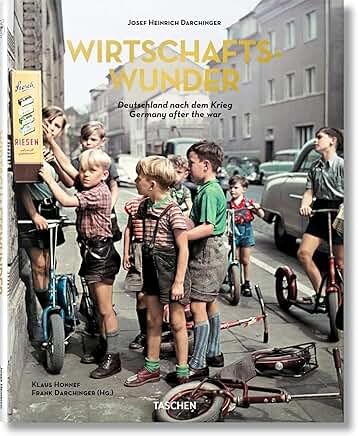
In the 1960s radical social and political change was in the air across western Europe. West Germany experienced its Wirtschaftswunder (“economic miracle”). Much of the infrastructure had been bombed to smithereens. Mass housing, commercial districts, railroads and factories were rebuilt overnight. Notoriously ugly, it nonetheless served its necessary purpose. American consumer capitalism, including American pop culture, was embraced uncritically. Even as the American liberators were warmly embraced, America was also met with deep misgivings—there was a strong anti-war movement against the USA’s involvement in Viet Nam.
The political and cultural stage for the golden age of gay West Germany was set by May 68. The youth-driven challenge to this conservative state of affairs began with the May 1968 student riots in Paris. It was a transformative, month-long period of civil unrest in France, starting as a student revolt against conservative education policies and capitalism. It escalated into a nationwide general strike involving roughly 10 million workers. It came very to becoming a full-blown revolution.
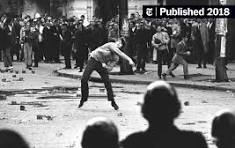
All France was shaken. May 68 was a profound social, cultural, and political crisis that challenged the authority of President Charles de Gaulle, paralyzed the nation, and marked a shift toward liberal views on personal freedom. It became one of the most significant social uprisings in modern European history. . Its spirit spread to West Germany and other parts of Europe, leaving a lasting legacy of radical thought and activism. Significantly, the French “alternative left provided ideological influences and spaces for gay action groups.”

This was the West Germany I encountered in 1970 when I moved to Mülheim-an-der-Ruhr as a high school exchange student. I knew I was gay and I had already had numerous sexual encounters with other (mostly) young men. Unbeknownst to me, the Stonewall riots had just taken place just a year before this. I kept my sexual orientation a secret. I had a girlfriend in Mülheim. We did not engage in sex and I never acted on my gay desires. I looked for signs of other gay men. I would go for walks along the Ruhr River promenade after dark. On a Sunday walk with my host family in the Fußgängerzone (pedestrian zone) of Essen I saw two men drunk and arguing loudly. One of them was crying. They were obviously a gay couple. I was both frightened and fascinated, a surprise public glimpse of a secret world. My host family acted as if they hadn’t seen this.
I returned to West Germany in 1974 as a Study Abroad college student. I had started to come out at college—motivated both by my first and only heterosexual relationship (which made clear how gay I was) and the presence of gay activists on campus—the GLF (Gay Liberation Front), the GAA (Gay Activist Alliance), and even Gay Maoists. I decided that when I got to Würzburg I would be totally and unapologetically out. No one knew me and I would not have to continue being rejected by friends. I made sure the first thing you knew about me was that I am gay. I became what the American press was calling a “militant homosexual.”
Little did I know that in 1974 I was stepping into what historians now call the Golden Age of West German gay culture and politics. I came out simultaneously as a gay man and a gay left activist. Jim May, another gay man in my Study Abroad group, and I joined forces to find any local gay bars. We started going to Jalousie, a pricy hooker bar, where we sure gay men would hang out. An all-lesbian jazz band from Prague played every night. The waiter was a stereotypical queen. This soon proved an expensive dead end. We went to Odion 2000, a disco downtown, and asked a bartender if there were any gay bars. She wrote down an address and gave me directions to a place across the Main River opposite the Altstadt. It turned out there were two gay bars across the street from each other, both discretely on a second floor and with no sign outside. One was an old-fashioned Kneipe that happened to serve a gay clientele. It had two rooms, one a bar and the other a dining room. It was often full of American GI’s. (Würzburg had a large US Army base.) The other bar, the Flocon, was trendy, with low-set lounge tables, low lighting and a micro disco dance floor.
The first time I went there I ran into my summer school German professor, Dennis Anderson. At first, I panicked, thinking he was acting as a truant officer. (I was already fluent in German and, finding his classes boring, stopped going to class.) Discovering we were both gay, we started a conversation that noight that lasted for five years. On our first date we went out to an Italian restaurant. After our second date we went to his apartment. And I never left. Before connecting with I had a brief relationship with Manfred, a local gay man. Manfred was a Lebensbornkind (“Fount of Life” child). a Lebensborn was a secret, SS-initiated, state-registered association in Nazi Germany intended to increase the number of children born who met the Nazi standards of “racially pure” and “heathy” Aryans. This “racial hygiene” (eugenics) was supposed to come about by paring unmarried women with “racially pure” and “heathy” fathers, particularly SS members as their families. Particularly fecund women were awarded the Cross of Honor of the German Mother. Mayna years later I learned about the rejection and ostracism Lebensborn children faced after World War II. They were often bullied, raped, abused, and persecuted by the government. In Norway the government placed them in mental institutions and tried to deport them to West Germany. My relationship with Manfred abruptly ended when his partner Peter came home and fond us in bed together. I had naively assumed Manfred was single.
One day there was a large hand written sign in the entrance to the Mensa (student cafeteria). An organization calling itself WüHSt [Würzburger Homosexuelle Studentengruppe] was offering a private space, whose address was kept a secret, for men who identified as gay to meet. There was a phone number to call to be given the address. WüHSt met in a private apartment, which had been rented out by an individual. The fact that it was the meeting place for a group of gay men no doubt did not remain a secret for long, given the apartment stood empty, except when a dozen or so young men who showed up on the same evening every week. We offered a safe place for gay men to come out and be supported, we had discussion evenings, and we held parties.
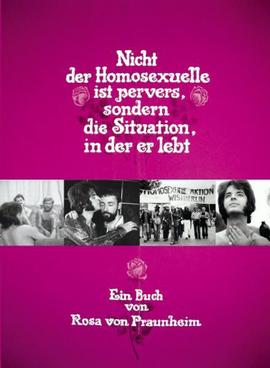
They were one of the early gay student activist groups that formed in response to seeing Rosa von Praunheim’s film Nicht der Homosexuelle ist pervers, sondern die Situation, in der er lebt (It Is Not the Homosexual Who is Perverse, But the Society in Which He Lives (In this film Praunheim approximated the American gay activists’ call “out of the closets and into the streets” as “Raus aus den Klappen und in die Strassen.” (“out of the public toilets and into the streets”). Praunheim and fellow gay activist and sociologist Martin Dannecker, who wrote Der gewöhnliche Homosexuelle (a sociological study of 789 homosexual men), toured West Germany, showing the film and leading discussions.). Its first TV broadcast was in 1972.
The film is set in West Berlin. Daniel is in a romantic relationship with another man. When it ends Daniel becomes kept by an older man, cruises for sex at the beaches, and ends up cruising public toilets at night. At the end of the film Daniel is shown “demoralized, depressed, and drunk at a well-known queer locale.” He runs into Paul, an old friend, who lives in a commune of gay student radicals. Paul invites Daniel to the commune which is his home. There they all engage in a theoretical discussion about the social and political predicament of gay men. “The most important thing,” one of the roommates argues “is that we must embrace our gay identity.” According to the film, gay men must build something new–a gay minority based on pride. The foundation for this to happen is for gay men to understand they are an oppressed minority. The film “aroused considerable disgust among conservatives and progressives alike.” The rhetoric of the film, however, was revolutionary. It “reimagined homosexuality as a political identity.” The film was “a polemical attack on West Germany’s gay subculture, which Praunheim saw as revolving solely around sex.” Praunheim’s film was a call to “solidarity on which the dream of gay political power rested.”
This sparked the creation of numerous gay activist groups, including WüHSt. Later historians have revised this very influential moment, arguing it was not the West German “Stonewall moment.” Praunheim and Dannecker framed gay men as a minority identity, much as the GLF in the US had done, redefining them as citizens, giving them a tool for political organization and action. The gay activist organizations that formed also drew inspiration from the American civil rights movement, feminist movements around the world, and anti-colonial movements. This did not prevent racism from flourishing in West Germany’s gay communities in the 1970s and 1980s, racializing both desire and disgust over Turks (who came to Germany as Gastarbeiter)and Black Germans (the children of Black American GIs and white German women).
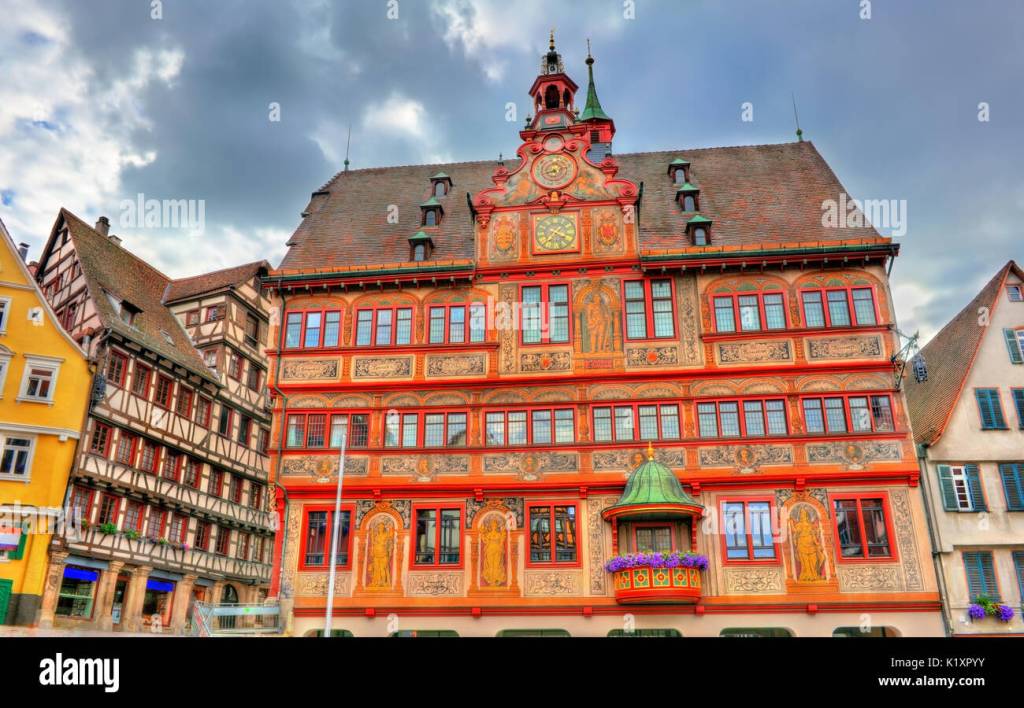
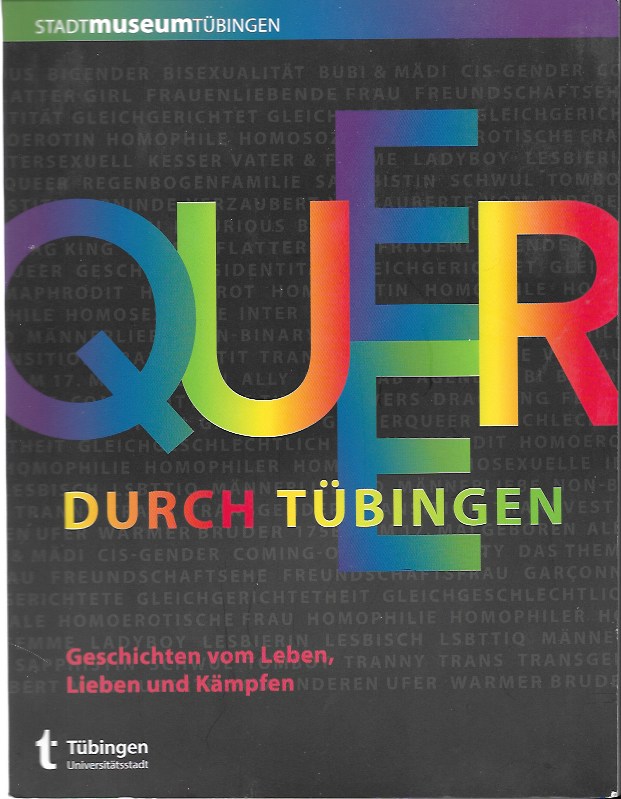
That year Dennis applied for a five-year position to teach American Studies at the University of Tübingen. He was hired, so I applied to pursue my graduate studies there. I continued my Comparative Literature concentration in Germanistik, Slawistik, and Amerikanistik. We quickly made a circle of close friends, both gay and straight, mostly couples, and mostly bilingual—a German partnered with an American, a Canadian, a Brit, an Australian, or a New Zealander. These friends, those who are alive, remain among my closest friends. I just got back [May 5, 2026] from a trip visiting my friends Barb and p\Peter Piel one of them in Bonn.) We were publicly out as a couple. We rarely encountered homophobia in Tübingen. We were included as a couple in all American Studies Department events. Because I was Dennis’s partner I had no problem being hired to teach ESL at the DAI [Deutsch-amerikanisches Institut) and as a Hiwi [research assistant] in the English Linguistics Department. I wrote my research papers on gay-related topics, such as the gay sensibility of Jugendstil [the distinctly German variant of art nouveau] and sadomasochism in Who’s Afraid of Virginia Wollf? When I voiced my objection to the homophobic tittering that accompanied some lecturing in a seminar on Stefan George, the professor offered me class time to give a presentation on gay activist perspectives.
Dennis and I discovered Pub 13, Tübingen’s gay bar located in a working-class neighborhood. It was a social gathering point and the only place where locals and students mixed. In those days gay bars were the only safe spaces where we could get together socially. Gay men also met in a kind of private club run by a lesbian called Jeanne. The space was inside an abandoned building in the Altstadt and had no address. Jeanne bought alcohol at a store down the street and carried the boxes to her club. It also served as a small art gallery. You knew you had “arrived” if she invited you to an exhibition reception at her gallery.
One presence in the 1970s that fostered the tolerance Tübingen has been historically noted for was from Christoph Müller (1938–2024), the editor-in-chief of the Schwäbisches Tagblatt, the daily newspaper. He significantly shaped the paper’s progressive line. He and his partner were an openly gay couple. The gay community greatly benefited from Müller. He used his influence, working behind the scenes to open doors for the gay community. He made judicious introductions. He saw that gay and lesbian groups were allowed to use city spaces. He frequently included gay-positive perspectives in the Schwäbisches Tagblatt.
Another presence was the arthouse cinema Kino Arsenal. The 1970s was the era of the Neues deutsches Kino [New German Cinema]. Dennis and I went to Kino Arsenal every weekend to see the latest German film. These often amazing films could be made because the federal government provided funds no strings attached. This gave film directors the freedom to make the films they envisioned, without compromising in the hopes of commercial success. Rainer Werner Faßbinder was arguably the most important of this generation of German filmmakers. Openly gay in an in-your-face manner and a notorious enfant terrible“because of his provocative, boundary-breaking, and self-destructive behavior, both in his filmmaking and personal life. Fassbinder challenged postwar German society and often focused on the “exploitation of emotions,” creating uncomfortable, honest, and controversial work that defied conventions. He was a volatile creative force who challenged bourgeois society, abused his cast and crew, and led a reckless, hedonistic lifestyle.” He was described as demanding, loud, and cruel, often manipulating his tight-knit creative team and lovers. He was incredibly prolific, sometimes making seven films a year, while simultaneously managing extreme drug, alcohol, and cocaine addictions. His life was marked by public scandal, intensive sexual adventures, and a “wild self-destructive libertinism.” (I remember seeing him once in the Deutsche Eiche, a restaurant in Munich with a large gay clientele. He looked very unhappy. One of my tablemates whispered me to that he was not well liked by the Deutsche Eiche crowd.)
Faßbinder is noted for his “BRD Trilogy” —The Marriage of Maria Braun (1979), Lola (1981), and Veronika Voss (1982). Most of his films focus on West Germany during the Wirtschaftswunder of the 1950s. He focused on (1) the issue of “forgetting the past for the sake of moving to a brighter future,” (2) the question of who exactly benefited from West Germany’s economic progress (Fassbinder’s view was that some Germans advanced during the “economic miracle” but others fell by the wayside), and (3) the inclusion of African American soldiers, who for him represented the influence of the American occupation of postwar Germany. Faßbinder addressed racism in Germany in his films, such as Angst essen Seele auf. Fassbinder’s treatment of women in his films is complex and contradictory, featuring profound empathy for their oppression in patriarchal society while often presenting them as complicit in their own victimhood. His characters navigate survival, exploitation, and power struggles. He frequently places women at the center of his narratives, portraying them as both victims and perpetrators of emotional manipulation, often exploring how they use their oppression as an “instrument of terror”.
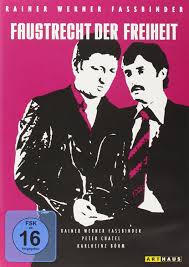
The Faßbinder film that had the most impact on me was Faustrecht der Freiheit (Fox and His Friends) (1975). “The plot follows the misadventures of a working-class gay man who wins the lottery, then falls in love with the elegant son of an industrialist. His lover tries to mold him into a gilt-edged mirror of upper-class values and ultimately swindles the easily flattered “Fox” out of his fortune. The film is an incisive look at the relationship between money and emotions. Love is seen as a commodity that can be bought for money and lasts only as long as it is profitable.”
I continued my gay activism as a member of the iht [Initiativgruppe Homosexualität Tübingen].I learned about the group when they advertised a gay dance to kick off the new 1975-76 academic year. The first meeting I attended was held in a university building in the Altstadt. After that we met in founding member Bernd Müller’s apartment. We held discussions, one of which was Carl Wittman’s “Refugees from Amerika: A Gay Manifesto” (which I had translated into German). We ate in restaurants as a group. We organized a weekend of workshops and invited other gay student activist groups. It culminated in a Tunten-Revue [drag review], where I made my first appearance on-stage in genderfuck drag.
After reading Larry Townsend’s now classic The Leatherman’s Handbook, I came out in the leather subculture in Munich. There I met Tad Baugh, my first leather master. Tad was American, he taught high school German and Russian, and he lived in the Castro District in San Francisco. He was in West Germany on a sabbatical year to refresh his German skills. When he returned to San Francisco he coaxed me into moving to San Francisco and living with him. In 1979 I moved in with him in his Castro Street apartment.
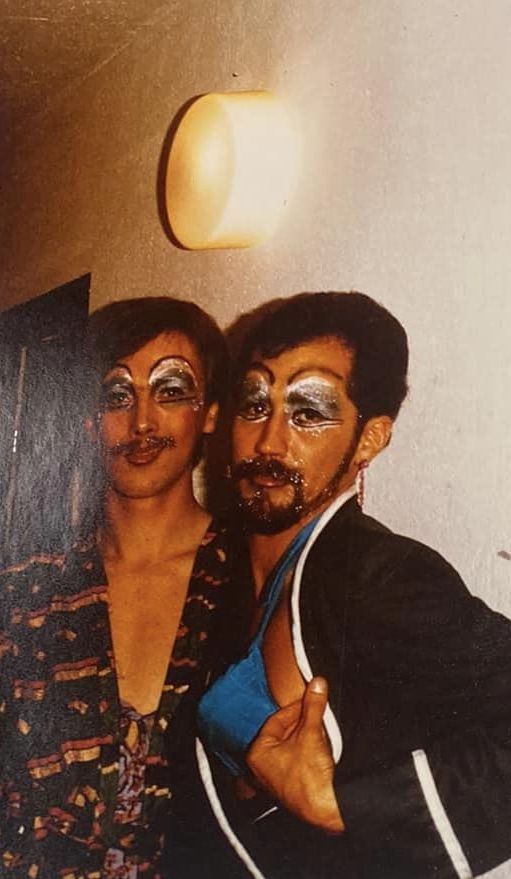
Gay activism in West Germany was also sparked by the Stonewall uprising. Moxt West German gay activists identified as socialists or communists. They replaced the word “homophil” with “schwul [gay male],” just as American gay activists replaced “homophile” with “gay.” Gay left activists often failed to differentiate between conservatism and fascism. They had an uneasy alliance with traditional leftists in West Germany due to the latter’s homophobia. (The Communist view was that homosexuality was a symptom of capitalist degeneration.) Gay conservatives were antagonized by the outrageous public face of activists. Conservative gay men attacked both effeminate gay men and activists (who attacked them for dressing conservatively). Homophile activist Craig Alfred Hanson objected to the “rigid examples of conformity—in dress, thought, and action in some of the professional non-conformist [gay activists].” “Just as a masculine or hypermasculine appearance was not necessarily conservative, it was by no means the case that gay leftists always favored a more androgynous style. Indeed, the most contentious debate in the history of the HAW {HomosexulleAktion Berlin] was the so-called Tuntenstreit (“queens’ dispute”), sparked by Italian and French activists who wore drag during a demonstration organized by the HAW in West Berlin in June 1973.” “Some of the participants had full beards and wore long dresses, eye shadow, and blue nail varnish” (in other words, “genderfuck drag”). They argued that gender conformity, and not social class, was a far greater foe to the capitalist class system. After 1969, “shame was not vanquished by pride, the pushes of revolt and resistance sat uneasily alongside the pulls of the desire to be accepted. Gay men remained often deeply ambivalent about themselves.”
A gay press emerged, including an explosion of ‘zines (called Infos), most notably Emanzipation and Schwuchtel, and three glossy magazines, du und ich, him, and Don. Several gay films were made: the afore-cited It Is Not the Homosexual Who is Perverse, But the Society in Which He Lives and Faßbinder’s Faustrecht der Freiheit, along with Frank Ripploh’s Taxi zum Klo. The film is a dark comedy of manners that explores the life of a Berlin school teacher (Ripploh) and the contrasts between his public and private lives. Ripploh intended his autobiographical film as an act of revenge after being fired from his public school teaching job, and not intended as a political statement. The ironic film is remarkable above all for its openness in its portrayal of gay sexuality, which was unmatched then and still is today. There are numerous scenes including gay cruising and encounters including unsimulated sex and erect penises visible in sexual acts at glory holes in public toilets. The title refers to the public toilet (Klo) as a place for casual gay sex. The Village Voice hailed it as “the first masterpiece about the mainstream of male gay life.” It achieved a cult status among audiences of the time (of which I was and am one). I find the film an accurate and honest document of actual gay life of the time. This was the West German gay subculture I lived in.
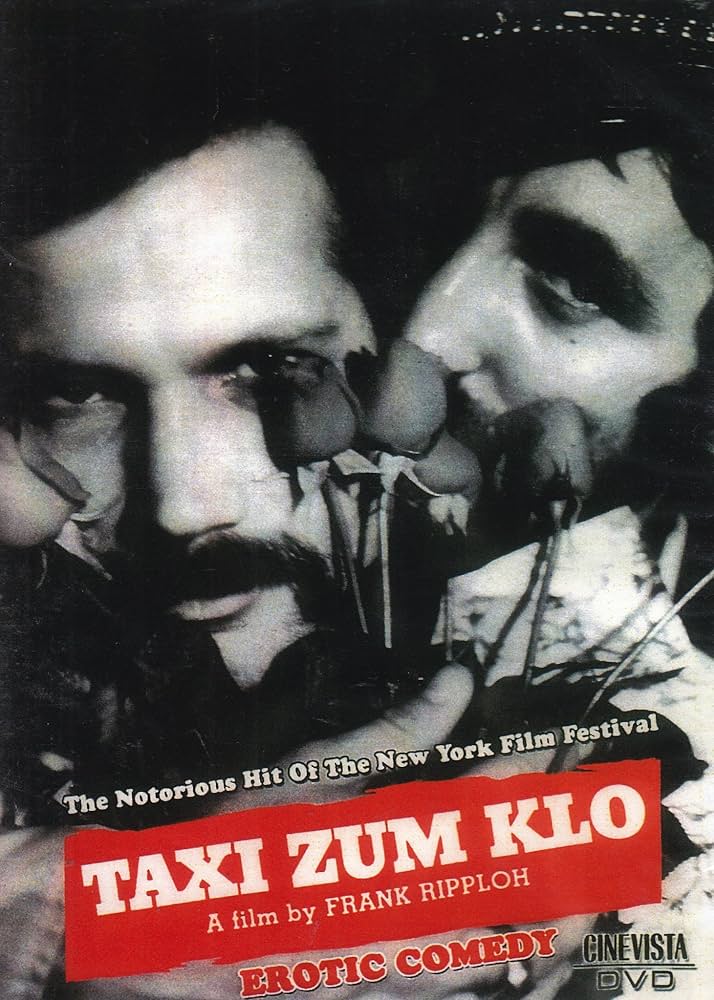
Taxi zum Klo, either explicitly shows or implicitly touches upon the issues of the day. These include (1) the oscillation between verklemmt (inhibited) and self-acceptance, (2) the generational conflict in gay community (pre- and post-Nazi Germany), (3) the touchy issue of gay cruising grounds (Klappen, train stations, public parks, libraries, art museums, and the like), which was a divide between radical and assimilationists politics—the wavering between pride and shame, normal and different, hope and fear, and (4) the risk of coming out due to Berufsverbot, a legally or administratively imposed ban in Germany preventing an individual from exercising their profession, occupation, trade, or branch of trade. Homosexuals were banned from all civil service jobs. West Germany had a vast civil service, which included all public school teachers (hence Ripploh being fired).
In 1979 Homolulu, a week-long “dance of the gays on the volcano,” was held in Frankfurt-am-Main. The Frankfurt gay activists declared the 1970s “the decade of homosexual emancipation” to “bury hetero-chauvinism under its queer lava.” The golden age of the 1970s saw the creation of a gay rights organization in 53 cities and towns. Gay historian Craig Griffiths has written that gay liberation in West Germany was “never some queer, utopian, hedonistic interlude.” Writing from the perspective of 2021, Griffiths argues that West German gay liberation was “never only about pride, but also about shame; characterized not only by hope, but also by fear; and driven not just by the pushes of confrontation, but also by the pulls of conformism.”
 Les K. Wright
IT’S WONDERFUL THAT YOU CHRONICLED GERMANY’S LGBT HISTORY.
Given what’s going on in the States, what do you feel about the future of our community with these current conditions. I now live in Van Anda, British Columbia but have homes in Raymond, Washington as well as inherited a medium-sized ranchito/animal sanctuary outside Santa Fe, New Mexico.
Logan Chrysler-D’Otard Yanegwa Entertainment Limited and Leather Bear Motorsports Limited.
LikeLike